
Divine Intersexuality
The Imperial Roman View of the Sleeping Hermaphrodite

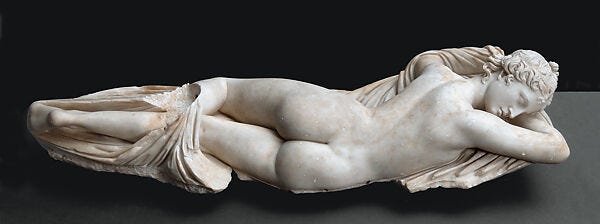
Images of the divine child of Aphrodite and Hermes are not uncommon in Imperial Roman domestic spaces. Hermaphrodite, (typically written as Hermaphroditus, although I chose in this article to use a gender neutral name and pronouns for them), appears across Imperial Roman art, from wall frescoes to sculptures in peristyle gardens. Consequently, Hermaphrodite becomes an essential figure in the Roman home, influencing public opinion on the home itself and prompting conversation between the home owner and guests. However, the perception of Hermaphrodite as a god-like figure drastically differs from that of intersex individuals with similar sex characteristics. Imperial Roman society saw intersex people as a net negative, while simultaneously understanding Hermaphrodite as a positive addition to the home. The Sleeping Hermaphrodite sculpture type consists of 2nd century examples of domestic artwork featuring an intersex individual, but the sculptures’ aesthetic composition independent of subject matter eclipses the Roman understanding of intersex births. This is certainly true in other cases of Sleeping Hermaphrodite-type sculptures, and their inclusion in Roman homes does not mirror Roman popular thought on intersexuality. The divinity of Hermaphrodite, and the inclusion of this figure in sculpture, makes the intersex individual in this case an acceptable possibility, while for intersex individuals born in Imperial Rome, the sheer fact of their existence was challenged by political and religious authority.
It is important to note that the Roman understanding of physical sex and gender was based on the active/passive roles filled by men and women that, according to Corbeil, “were thought to typify the two sexes.”1 Sexuality was determined based on the sexual role played by the individual. Mazo-Karras aptly explains:
“Key to the distinction of gender roles was the concept that men are active and women are passive, or that men are penetrators and women penetrated. Thus anyone who is penetrated (or is in other ways passive) is gendered feminine, and anyone who penetrates is masculine. For the Romans, to penetrate other men could be a sign of masculinity… Women who penetrate and men who are penetrated are seen not primarily as sexual deviants but as gender transgressors.”2
Further, gender was not determined on the basis of outward appearance but rather on the individual’s sexual role, whether passive or active, penetrated or penetrator. This could also theoretically be tied to the individual’s physical sex, but it was not uncommon for these roles to become reversed in certain scenarios of gender transgression. Gender transgression, here, implies that gender roles, when reversed, were not accepted in Roman society. Hermaphrodite would have been seen as a gender transgressor following this framework—the nymph Salmacis, a traditionally penetrated female, morphed her body with that of Hermaphroditus, a male penetrator, creating Hermaphrodite. One could argue that, in this case, Hermaphrodite had taken a passive role while still having more masculine sex characteristics. This kind of transgression was not taken lightly by Romans, with men who “transgressed” labeled as cinaedus, or a derogatory term for a male who desires penetration by another male. A cinaedus was seen as effeminate and lacking as a “man”, or vir, based on the gendered nature of his sexual role.3 Even so, Hermaphrodite was still an acceptable image to find in a Roman home, despite the implications of their intersex experience. This links to the idea of divine androgyny; Hermaphrodite’s divinity could have been the sole factor of their identity that made their intersexuality acceptable to Roman society, to the point that they were used as a symbolic feature in gardens. It was their divine status that allowed them to exist in Roman domestic spaces. Simultaneously, intersex people were treated poorly at the hands of religious and political officials, despite the existence of a god-like figure that bore their same body type. This dichotomy persists throughout the Roman Imperial period and provides a rather confusing and paradoxical understanding of intersex identity during this time. I argue that without Hermaphrodite’s divinity, they, along with intersex individuals born in Imperial Rome, would have likely have been viewed as something to fear. However, since Hermaphrodite is the child of Aphrodite and Hermes, a god in their own right, their intersex identity was scorned yet also celebrated. In this way, Hermaphrodite embodies both the feminine and the masculine, exhibiting divine intersexuality rather than androgyny.
Divine Androgyny/Divine Intersexuality
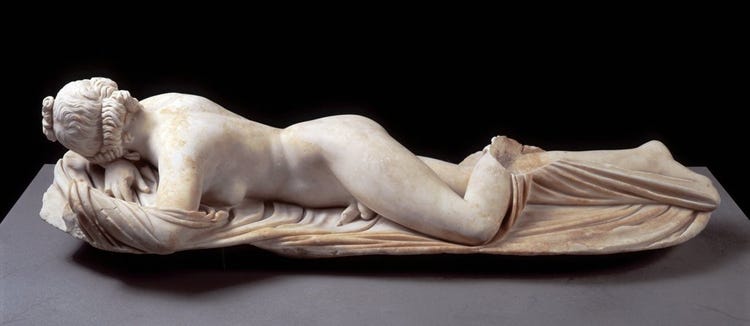
Divine androgyny can be defined by the proclivity of a god to embody the traits of a gender apart from their assigned gender at birth, a scenario many gods experience throughout their mythologies.4 For example, the goddess Athena was “born” from her father Zeus’s head, yet no mother is mentioned in her story. In this way, Zeus takes on a more passive gender role in the Roman view, making his gender in this tale rather ambiguous and unrelated to his physical sex. The Sleeping Hermaphrodite sculpture, in turn, exhibits a similar sense of gender ambiguity, however one cannot consider Hermaphrodite to be androgynous, but rather intersex. Intersexuality in the modern view is defined by the presence of sexual organs on a person that do not necessarily correspond to a binary understanding of physical sex. Hermaphrodite clearly exhibits divine intersexuality rather than divine androgyny as a result of their physical sex characteristics, not the gender they choose to present.
Hermaphrodite’s divine intersexuality originates from multiple sources. Some scholars point out that an intersex god born of Aphrodite and Hermes was worshipped through cult practice prior to the first century BCE, but the story of the spring of Salmacis from Ovid’s Metamorphoses provides a newer version of the story behind Hermaphrodite that would have been commonly referenced among Imperial Roman elites.5 Before Ovid, oral tradition may have referenced an intersex child of Aphrodite and Hermes, and that Hermaphrodite’s intersexuality resulted from their birth. However, Roman thought on Hermaphrodite largely followed Ovid’s mythology as outlined in his story about the spring of Salmacis.
As Hermaphrodite’s tale unfolds, the reader meets Hermaphroditus, a young man who catches the eye of the nymph, Salmacis, while bathing at her spring. Upon meeting Hermaphroditus, Salmacis becomes entranced by his beauty and asks the gods to morph her body with his to become one. After a physical struggle between the two, the gods grant Salmacis her wish and Hermaphroditus becomes Hermaphrodite, his male body molded with that of the female nymph.
Through Ovid’s tale, gender roles are reversed and both Hermaphrodite and Salmacis become gender transgressors. First, Salmacis subverts traditional understandings of nymphs as delicate and ready to be wooed through her actions towards Hermaphroditus. Her identity contrasts with the traditional view of a nymph as “obsessed with hunting and virginity,” and she is described by Ovid in ways that specifically counter the fragile, virginal nymph trope. Robinson points out that the behavior of Salmacis in this story directly contradicts that of other nymphs written about by Ovid:
“Salmacis is seen combing her hair and spending time on her appearance, quite unlike nymphs such as Daphne and Callisto; and she is dressed in light gauzy material, rather than something less comfortable. Her polar opposition to the life of hunting suggests a similar opposition to the life of virginity.”6
Further, Salmacis plays a different role in this story than Robinson’s “raped nymph,” and instead takes on the characteristics of a lustful god as she chases after Hermaphroditus moments before their collective transformation.7
Hermaphroditus, in turn, exhibits more feminine traits even prior to metamorphosis. When Salmacis first encounters him, Hermaphroditus “blushes” at the propositioning nymph and rejects her advances, undressing before bathing in the spring under her watchful eye.8 Here, Hermaphroditus’s actions resemble the mythological trope of the bathing goddess, communicating a sense of feminine allure to the reader. Hermaphroditus, then, becomes Hermaphrodite upon morphing bodies with Salmacis, but Salmacis disappears following their merge. Hermaphrodite is left alone, with a feminine frame and a penis, and is described by Ovid in “terms of effeminacy.”9 According to Robinson, the term hermaphrodite had a dual meaning, referring to the physical constitution of Hermaphrodite as having male and female sex characteristics while simultaneously implying that, by merging with Salmacis, Hermaphroditus had been emasculated.10 It was assumed that, through their transformation, Hermaphrodite embodied more feminine traits and was viewed as weak. However, despite the negative notions surrounding Hermaphrodite’s new physical sex and gender transgressions prior to the transformation, images of Hermaphrodite were common in Roman spaces. Hermaphrodite’s divinity is the sole factor explaining why images of them were acceptable, but intersexuality as a concept was unfathomable to the average Roman. Intersex births were viewed as an impossibility, divinely inspired phenomena that must be evidence of the wrath of an angry god.
Roman Intersex Identity & Its Responses
What, then, is the difference in the response of someone living in Imperial Rome to intersex identity and divine intersexuality? Divine intersexuality, seen in this case through Hermaphrodite’s metamorphosis, was acceptable in the Roman mind. However, intersex identity was not. Citing Corbeil, one can quickly understand the varying attitudes of Romans toward intersex people compared with those towards Hermaphrodite. Contrary to popular belief on the subject, intersex births were not seen as a bad omen per se, but rather the response of a god’s wrath. Essentially, an intersex birth was not predictive and did not have negative implications for the future. Instead, births of this nature were seen as a disruption in the natural world order and, according to Corbeil, “signs of divine anger.”11 Intersex births appeared to attract more attention by the Roman public in times of political or social turmoil and as a result of the implication of an angry god through this type of birth, intersex people were often “put aboard a ship and cast out to sea…where the purifying water prevented any future consequences from being visited upon the Romans.”12 As an alternative to an almost certain death, intersex children may have also been presented and handed over to political and religious authority figures, and those in power were responsible for deciding the child’s fate. In the case that an intersex individual was allowed to survive, it was understood by Roman law that “a third sex was impossible,” so matters of inheritance were determined and settled based on the genitalia or sex organs predominating the individual’s body.13 Thus, if the individual had a penis, they would be treated as male.
As such, intersexuality itself must have been seen as divine. It was seen as impossible for a person to be intersex until an intersex birth occurred, and upon their birth, their intersexuality was inherently tied to divinity and divine intervention. This may help to explain why images of Hermaphrodite were acceptable forms of decoration. Trimble argues in her essay, Beyond Surprise, that the sex of Hermaphrodite may not have mattered to Roman audiences in the way it would today. She notes that Hermaphrodite was “not an obscure mythological figure” and that an elite, educated Roman encountering a sculpture of Hermaphrodite may be familiar with Ovid’s tale or other stories surrounding them.14 Consequently, the response to viewing an artwork of Hermaphrodite would not have been a negative one, but rather it may have sparked further conversation based on the setting of the work itself. This duality between the response to Hermaphrodite and intersex births reveals that Hermaphrodite’s divinity made their intersexuality palatable and acceptable.
Hermaphrodite & Bartman’s “Sexy Boys”
Bartman’s “sexy boys” may help to explain why the identity of the Hermaphrodite was accepted, when intersex individuals were scorned by authorities. In Eros’s Flame: Images of Sexy Boys in Roman Ideal Sculpture, Bartman defines “sexy boys” as “images of youthful males characterized by a soft, just-pubescent physique and a relaxed, soignée pose.”15 These “sexy boy” sculptures had characteristics that resemble those of the Sleeping Hermaphrodite sculpture type. Looking specifically at the Sleeping Hermaphrodite sculpture from the Palazzo Massimo (Fig. 1), one notices the similarities in the sensual pose of the figure compared to Bartman’s “sexy boys,” including a sculpture of Paris from the Musei Capitolini in Rome (Fig. 2). One leg crosses over the other in both sculptures, and each exhibits an exaggerated stance, with weight resting predominantly on one leg rather than both. While contrapposto was a common feature in Greco-Roman sculpture from the Classical period onward, the exaggerated jutting-out of the figure’s hip emphasizes the feminine curve of the waist. Bartman notes that “just as many ‘sexy boy’ statues pose in a manner that Romans would have considered distinctly unmanly, so too do their body types suggest effeminacy.”16 This is also the case with the Sleeping Hermaphrodite sculpture, as the reclined pose suggests a sense of vulnerability and thus sexual availability to a male viewer only possible in Roman society through the feminine. The facial expressions of Bartman’s “sexy boys” and the Sleeping Hermaphrodite sculpture seem to mirror each other. Their serene faces, the Hermaphrodite in sleep and Paris awake, are similarly feminine, with soft cheeks and brow bones in contrast to angular, hyper-masculine images of important Roman men.
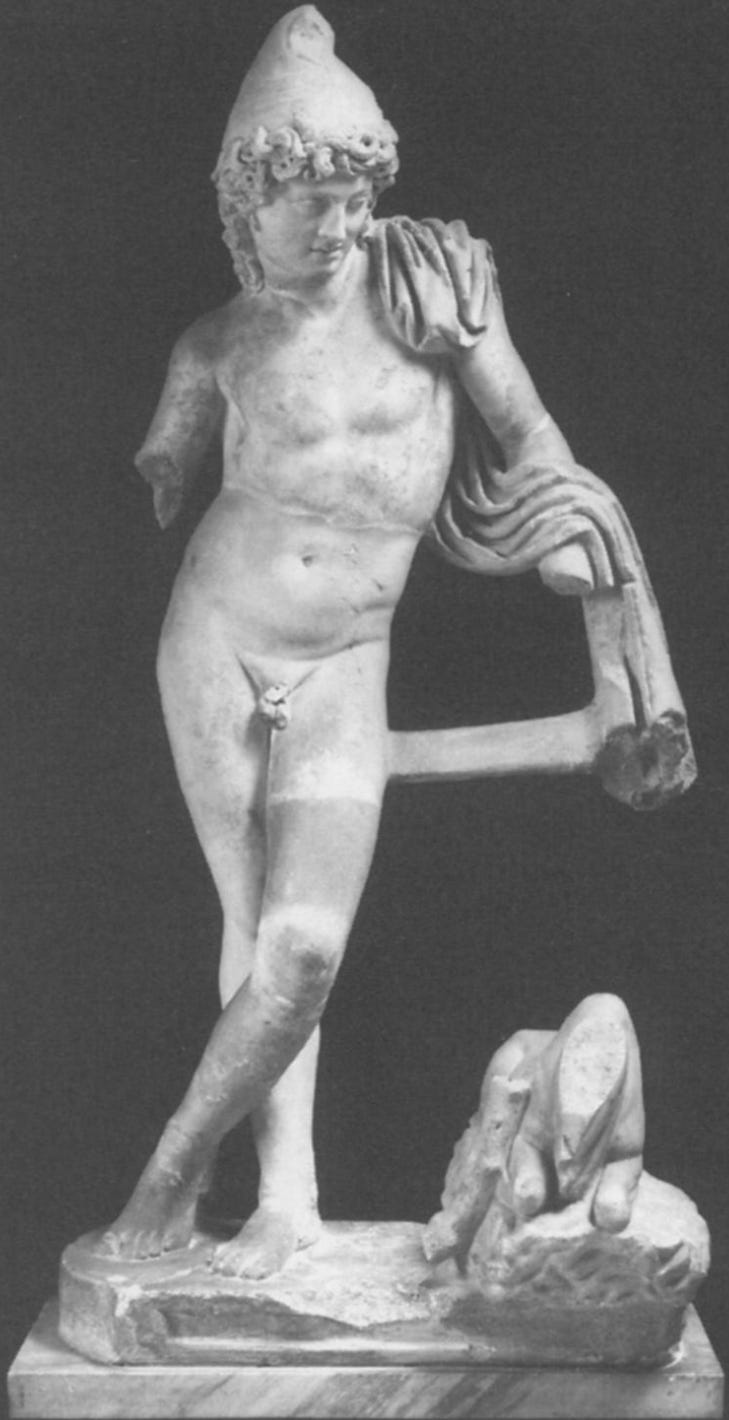
However, it is essential to note that the Sleeping Hermaphrodite is not a “sexy boy” and instead is divinely intersex. The difference here is that Hermaphrodite is not a man or a boy at all, but they fall into entirely different categories that defy Roman understandings of physical sex and gender. Hermaphrodite in Ovid’s story is intersex and a gender transgressor, both emphasized through divine action at the Spring of Salmacis. While the Sleeping Hermaphrodite may have a similar body posture, hairstyle, and facial expression as Bartman’s “sexy boys,” they are an entirely different kind of sculpture. “Sexy boys” here are, in essence, feminine men. However, since Hermaphrodite is neither man nor woman, one cannot claim that they are a “sexy boy.”
The hairstyles of “sexy boys” and Hermaphrodite are similar to each other, yet each sculpture represents a very different understanding of gender and physical sex. Looking back at Paris from the Musei Capitolini, he is sculpted with carefully styled, wavy hair, with a braid leading from the front of the face to the back of the head where it combines into a stylish knot. Bartman notes here that the hair styles of “sexy boys” may not always be indicative of the masculine or feminine, instead they may be something else entirely: “Some of the hair arrangements found on other sexy boy statues, however, bear little relation to traditional styles worn by either men or women. The thick corkscrew curls ringing the faces of many representations of Paris, for example, seem an artist’s invention, deliberately concocted to convey the foreign character of its subject.”17 Such is the case with the Sleeping Hermaphrodite. The hairstyle seen here is not a traditional male or female hairstyle, rather something altogether different, with curls framing Hermaphrodite’s face and a quasi-top knot atop their head. However, the reasoning for this kind of androgynous hairstyle lies, again, in Hermaphrodite’s divine intersexuality rather than being a “sexy boy” sculpture. While “sexy boys” and Sleeping Hermaphrodite have notable similarities, Sleeping Hermaphrodite sculptures cannot be seen as “sexy boys” at all.
Hermaphrodite in Garden Spaces
The Sleeping Hermaphrodite sculpture type was commonly found in garden spaces and influenced a visitor’s experience of one’s home. Again, it is the sculpture subject’s divine nature that makes their intersex identity understandable and accepted in the domestic space. Although there exist various arguments for the inclusion of Hermaphrodite sculptures in peristyle gardens, the figure’s dual sexuality and divinity make for an interesting experience of the Roman home that combines male and female spheres of life.
Images of Hermaphrodite were commonly found in areas of the Roman home that would have facilitated male/female interaction, combining the masculine and feminine spheres into one “hermaphrodized” space.18 Von Stackelberg comments that the movement in the home was “male-centered,” while female domestic activities were often marginalized.19 However, it is not just the simple combination of male and female spheres of life that provides a rationale for the inclusion of Hermaphrodite imagery in gardens, but the association of Hermaphrodite with their mother, Venus. Venus is both the “Italian goddess of gardens” and the mother of Hermaphrodite, providing some understanding as to why Hermaphrodite belonged in these spaces. Von Stackelberg also suggests visual similarities between the bodies of Venus and Hermaphrodite when depicted in sculpture, which may also indicate an overall acceptance of Hermaphrodite in gardens. Peristyle gardens were meant as multisensory experiences, commonly combining sculpture with flora and water features to create a unique environment for home visitors.20 The Sleeping Hermaphrodite sculpture would have been one of several in the garden in which it was found, contributing to a program of other loosely related sculptures that would draw the eye in a particular direction, therefore influencing the movement and conversation of a visitor.
Hermaphrodite’s divine intersexuality would have both signaled to visitors that the garden was a site of male/female sphere crossover, but could have also been indicative of the garden as a divine space itself. While Roman peristyle gardens may not have explicitly been places of worship, the depiction of the Sleeping Hermaphrodite within the space points to the divine nature of the space itself, as the garden could be considered nature controlled in contrast to the dangers lurking outside its walls. One may speculate that a particular water feature in a garden that also housed a Sleeping Hermaphrodite could also remind those familiar with Ovid’s story of the spring of Salmacis, further allowing visitors to have a physical, sensory experience of the myth. After walking through a garden, one may feel more connected to the spiritual and the divine through this multisensory experience, as if the garden itself were a liminal space between the divine and reality.
Conclusion
While the Sleeping Hermaphrodite may be a surprising figure to encounter, particularly to a modern viewer, the Roman understanding of the sculpture would likely have been quite different. Intersex births, including Hermaphrodite, would have been viewed as divine phenomena and were treated as such, while our modern understanding of intersexuality is still contested. Throughout this paper, I have argued that the divine intersexuality of Hermaphrodite and the divine nature of intersex births made the myth of Hermaphrodite and the spring of Salmacis palatable to the Roman citizen. However, intersex people in contemporaneity experience significant marginalization and systemic oppression through the belief in the “traditional” male/female gender binary. Intersexuality in Imperial Rome was an impossibility, and even today, while intersex births occur naturally, it is treated as impossible to raise a child with sex characteristics that don’t align with the binary view of sex and gender. Intersex infants today still experience invasive surgeries that seek to change the perceived physical sex of the individual to more closely align the child’s characteristics with those of a binary male or female. The belief in a third gender, a third sex, or something entirely inbetween is altogether foreign to more conservative views of the gender binary. It is my hope that viewing the Sleeping Hermaphrodite sculptures will spark more interest in the concept of intersexuality as something that even the Romans experienced, that intersexuality and gender transgression are not new but rather have occurred since the dawn of civilization.
Citations & Further Reading
Bartman, Elizabeth. “Eros’s Flame: Images of Sexy Boys in Roman Ideal Sculpture.” Memoirs of the American Academy in Rome. Supplementary Volumes 1 (2002). https://www.jstor.org/stable/4238454.
Butler, Judith. “Performative Acts and Gender Constitution: An Essay in Phenomenology and Feminist Theory.” Theatre Journal 40, no. 4 (December 1988). http://www.jstor.org/stable/3207893.
Corbeill, Anthony. “The Prodigious Hermaphrodite.” In Sexing the World: Grammatical Gender and Biological Sex in Ancient Rome. Princeton University Press, 2015.
Farrar, Linda. “Roman Gardens.” In Gardens and Gardeners of the Ancient World, 138–84. Oxbow Books, Windgather Press, 2016.
Mazo Karras, Ruth. “Active/Passive, Acts/Passions: Greek and Roman Sexualities.” The American Historical Review 105, no. 4 (October 2000). https://doi.org/10.2307/2651412.
McGowan, Elizabeth. “The Sleeping Hermaphrodite: Reception and Interpretation in Three Eras.” In Roman Sculpture in Context, edited by Peter D. De Staebler and Anne Hrychuk Kontokosta, 6:75–97. Archaeological Institute of America, 2020.
Robinson, M. “Salmacis and Hermaphroditus: When Two Become One: (Ovid, Met. 4.285-388).” The Classical Quarterly 49, no. 1 (1999): 212–23. https://www.jstor.org/stable/639498.
Silberman, Lauren. “Mythographic Transformations of Ovid’s Hermaphrodite.” The Sixteenth Century Journal 19, no. 4 (1988): 643–52. https://www.jstor.org/stable/2540991.
Trimble, Jennifer. “Beyond Surprise: Looking Again at the Sleeping Hermaphrodite in the Palazzo Massimo.” In Roman Artists, Patrons, and Public Consumption: Familiar Works Reconsidered, edited by Brenda Longfellow and Ellen E. Perry. University of Michigan Press, 2018.
Von Stackelberg, Katharine T. “Garden Hybrids.” Classical Antiquity 33, no. 2 (October 1, 2014): 395–426. https://doi.org/10.1525/ca.2014.33.2.395.
Vout, Caroline. “The Erotics of Imperium.” In Power and Eroticism in Imperial Rome, 1–39. Cambridge University Press, 2007.
Corbeill, “The Prodigious Hermaphrodite,” 4.
Mazo Karras, “Active/Passive, Acts/Passions: Greek and Roman Sexualities,” 1255–56.
Ibid.
Corbeill, “The Prodigious Hermaphrodite,” 4.
Silberman, “Mythographic Transformations of Ovid’s Hermaphrodite,” 645.
Robinson, “Salmacis and Hermaphroditus: When Two Become One: (Ovid, Met. 4.285-388),” 218.
Ibid.
Ibid.
Ibid, 220.
Ibid.
Corbeill, “The Prodigious Hermaphrodite,” 8.
Ibid, 14.
Ibid, 22.
Trimble, “Beyond Surprise: Looking Again at the Sleeping Hermaphrodite in the Palazzo Massimo,” 31.
Bartman, “Eros’s Flame: Images of Sexy Boys in Roman Ideal Sculpture,” 249.
Ibid, 254.
Ibid, 258.
Von Stackelberg, “Garden Hybrids,” 397-398.
Ibid, 404.
Trimble, “Beyond Surprise: Looking Again at the Sleeping Hermaphrodite in the Palazzo Massimo,” 30.