
Encrypted Joy
Glitching Gender and Building Trans Worlds at Body Hack

Hi again! Here’s a chapter that I was going to put in my thesis before I left my MA program. I had no idea where to put it or what to do with all of the work I did, so I thought someone here might like it! I hope you get something out of it and enjoy reading it as much as I did while writing. As always, citations can be found at the bottom with footnotes!
When considering queer nightlife spaces, we must also turn to their online presences, as they tend to be intrinsically linked. New York City’s queer nightlife features pop-up events at a variety of physical venues while maintaining distinct visual aesthetics within their online worlds. These distinct visuals often include memes and flyers to bolster community interest in events while simultaneously creating a linked community of individuals with similar backgrounds in physical spaces. Body Hack, a monthly trans-centered rave and happy hour hosted in Glendale, Queens, utilizes online visual communication design to create community, and its posts act as tools of collective resistance, embodying what scholar Legacy Russell coins as the “glitch.”
Body Hack began as a fundraising and mutual aid collective, hosting some events online in 2020 at the onset of the COVID-19 pandemic. Before the pandemic, Body Hack was hosted at an astrology-themed bar in Bushwick, inviting people to dance to live DJ sets and raising money for QTPOC and sex worker-oriented organizations.1 After going fully online in 2020, PAPER Magazine pointed to BodyHack a “favorite Zoom happy hour/party [that] raises funds for trans and nonbinary communities around the world,” with a “stacked lineup” and twelve hours of music and other content.2 Body Hack exemplifies glitch—the event’s transition from fully online to in-person provided a space for attendees to don their digital skins in the physical world, creating an environment in which transgressive gender identity is, in fact, the norm.
It is essential to note the governmental influence on societal understandings of sexuality and gender on the internet, particularly in the highly polarized political climate of the United States. Within his first 90 days in his second term as president, Donald Trump stripped away rights for transgender Americans nation-wide, halting DEI (diversity, equity, and inclusion) efforts in federal agencies and stating in an executive order that “instructed government agencies [must] ensure that federally funded institutions recognize people as girls, boys, men or women based solely on their ‘immutable biological classification.’”3 Within days, the White House ordered federal agencies to end “Radical And Wasteful Government DEI Programs And Preferencing” by executive order, which claimed that the Biden administration “forced illegal and immoral discrimination programs, going by the name ‘diversity, equity, and inclusion’ (DEI)” within the federal government.4 Even the TSA website, which maintained a page explaining the rights of trans/gnc individuals while flying, changed to only include “LGB Passengers,” complying with Trump’s order to only recognize individuals by their biological sex.5 This erasure of queer and transness from the internet also extends to queer safe-havens like the Stonewall Inn. In February 2025, the letters “T” and “Q” were removed from the Stonewall National Monument website in yet another sweep of government references to queer and trans people. Although protestors quickly organized at the site, the website subsequently was left unchanged.6
The online erasure of queer and trans people also extends AFK. Donald Trump’s executive orders have also led to a mass halt in name and gender-marker ID or birth certificate changes initiated by trans/gnc individuals. Trans comedian, Reed Motti, commented on their experience with their struggle to change their gender marker and name on their government-issued ID on the queer online publication, Autostraddle, expressing their frustration with the Trump administration’s actions. Motti’s Autostraddle article listed a number of actionable items that they thought would be useful for trans/gnc people going through a name or gender-marker change process, encouraging those in the process to keep fighting and to not succumb to fear-mongering online.
“I know times are scary right now but just remember that trans people have existed since the dawn of time and will continue to exist far beyond our short time on Earth. They will never get rid of us. They could never erase us. I love you and everything will be okay.”7
Despite the fear instilled by Trump’s inflammatory rhetoric towards trans/gnc people, queer individuals and organizations remain steadfast in their efforts to look toward a liberated future. The online presences of queer people globally and locally combat efforts by various social media platforms to censor queer-centered content. This presence is, indeed, a “glitch” in the system, or “something gone wrong.”8 By simply posting online and sharing resources within the community, queer people look forward to a future in which true liberation is possible. José Esteban Muñoz in Cruising Utopia hypothesizes that
“The here and now is a prison house…Some will say that all we have are the pleasures of this moment, but we must never settle for that minimal transport; we must dream and enact new and better pleasures, other ways of being in the world, and ultimately new worlds.”9
While the algorithms that power social media sites like Instagram and Tiktok can help users create their own online worlds filled with personalized content, they can also hinder the promotion of materials created by people from marginalized communities. The Instagram algorithm in particular has proved harmful for queer people, as content is often censored when it is deemed “inappropriate” or contains words or phrases that relate to queerness. Carolina Are writes about her experience as a woman on the internet, stating that women’s bodies in particular fall under scrutiny on social media, while male bodies often do not receive the same treatment. This also applies to trans and gender nonconforming bodies, as non-cis-male bodies are surveilled in a similar fashion online. Are further notes that “women’s bodies, nudity, sex and sexuality also bear the brunt of social media’s algorithmic censorship, replicating the male gaze online.”10 While the male gaze is certainly not the only factor impacting the censorship of transgender bodies online, it contributes to the “othering” of trans people online and AFK. However, by existing in online spaces that traditionally cater to the cisgender male gaze specifically, queer nightlife organizers create safe(r) online communities that also translate AFK.
The online presences of queer nightlife organizers exemplify glitch and the potentiality of the community through their unique design elements, harnessing the power of the present moment to make this new, utopian world a reality. By signaling queer identity in disruptive, counter-cultural ways on social media platforms queer nightlife organizers glitch traditional uses of the platform and combat rampant censorship by creating micro-communities within the larger queer milieu. By owning the night and, further, owning the online domain, queer nightlife organizers seek to overcome notions of binary gender and compulsory heterosexuality, inviting trans/gnc individuals into a utopian world that translates online and AFK. This essay will primarily highlight the online presence of BodyHack, a monthly party and fundraiser that centers the trans community, hosted at Nowadays in Glendale, Queens. Although the physical space BodyHack inhabits is significant, the event’s Instagram page has become a staple in online nightlife culture.
BodyHack’s emoticon-filled Instagram bio reads, “‧₊˚ ✩°。⋆♡ A Happy Hour + Afterparty for trans people, nonbinary cuties, & the squirrels that love us. ♡⋆。°✩˚₊” maintaining a distinct digital aesthetic that utilizes colloquial symbols of transness and early 2000s imagery to grab viewers’ attention. BodyHack knows its online audience quite well, as the event series’s Instagram account had more than 25k followers as of March 2026, with its numbers only growing with each event announcement. Posts typically receive several hundred to thousands of likes with an active comments section. BodyHack’s online presence and AFK event promote t4t (trans-for-trans) relationships and encounters, creating an insular community that is self-contained and self-protected. The term t4t implies the breaking of cisheteronormative relationship stereotypes within queer romantic and sexual relationships. This dynamic can be found throughout BodyHack’s posts for each of their events, linking the event with queer cruising spaces.
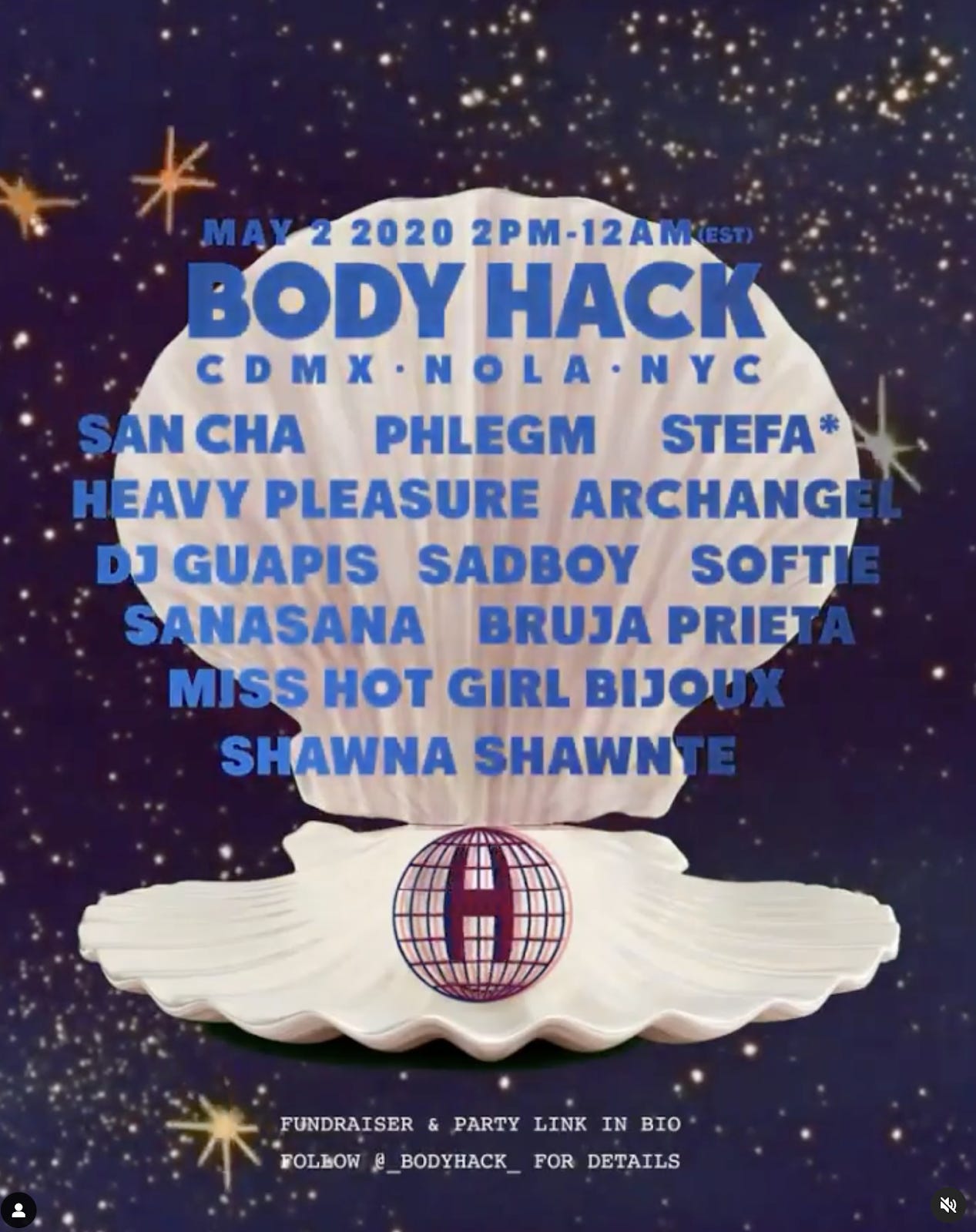

BodyHack posted their inaugural Instagram post spotlighting their first online event in April 2020, Figure 1. This first iteration of BodyHack online raised funds for the organizations For the Gworls, based in NYC, the Sex Worker Fund, based in LA, and C.A.I.T., based in Mexico City. Through this digital event, BodyHack aimed to raise $4k for these grassroots organizations to support trans and nonbinary sex workers internationally. Their first video post featured a dynamic celestial background, blurred to look like the footage quality found on a VHS tape. At the center of the screen rests a seashell opening and closing to reveal a pearl, which resembles a disco ball and flashes letters spelling out “BodyHack” in a sans serif font. The body text on the moving shell alternates between multiple hues, ranging from pink to blue to yellow, reading, “MAY 2 2020 2PM TO 12AM (EST) / BODYHACK / CDMX / NOLA / NYC,” followed by the names of the DJs performing throughout the event. The seashell is clearly animated, but its clarity does not match the blurry background. Further, the celestial background of the post, featuring twinkling stars and animated graphics to look like computer code, does not seem to complement the seashell either. Rather, the sky and the seashell, adorned with the disco ball-like "pearl," appear to be out of place. By situating completely unrelated elements in one field, BodyHack’s graphic designers create a new world in which the absurd is celebrated. The shell and juxtaposed celestial background exist simultaneously in cyberspace, allowing the audience to enter into a dreamlike and mind-bending state.
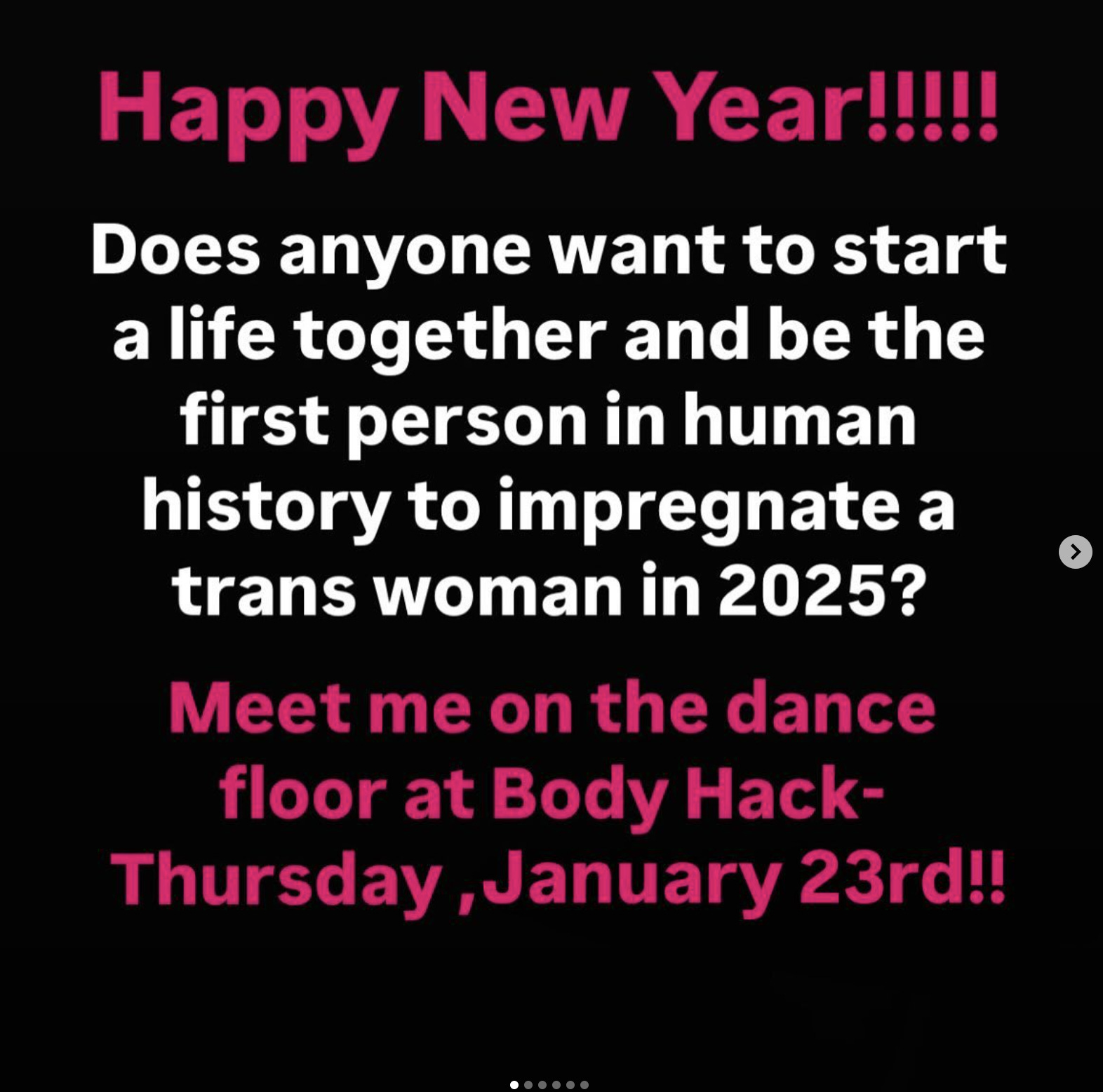
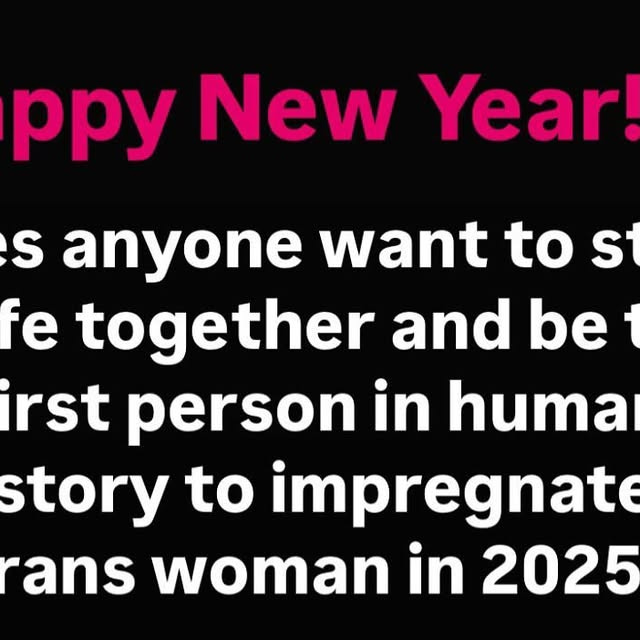
BodyHack’s social media presence does not maintain one single visual aesthetic throughout. Its posts are sporadically and inconsistently designed, with only some overlap. However, the one area in which the images intersect is within text-heavy posts featuring a sans serif font that is easy to read. The simplicity of the font here is likely meant to ensure that the viewer pays more attention to the message and the content of the post rather than to the visuals of the post itself. BodyHack’s iteration in January of 2025 was initially advertised by a pink and white text post on a black background in simple sans serif typeface, reading, “Happy New Year!!!!! Does anyone want to start a life together and be the first person in human history to impregnate a trans woman in 2025? Meet me on the dance floor at BodyHack–Thursday, January 23rd!!” (Figure 2). The text in fig. 2 is intentionally provocative and may seem confusing to a majority cisgender audience. By inviting someone to be the “first person in human history to impregnate a trans woman,” BodyHack assumes a mostly trans/gnc audience for its posts. Is there a world in which a trans woman could become pregnant? BodyHack asks this question and invites a queer utopia to exist within Nowadays’s physical venue and BodyHack’s online world, envisioning a new space in which sex and gender are simultaneously relevant and deconstructed.

Fig. 3 of the same post includes a similarly simple composition with white-on-black background sans serif text, reading “Short King competition next BodyHack during our happy hour. The prize is me btw.” The post jokingly implies that there will be an unspecified competition among transmasc BodyHack attendees, and the prize is an anonymous “me,” or the person who created the post—likely another trans person. This plays on a cisgender stereotype of the “short king,” as described by Sophie Caldwell in a Today article from 2024.11 Caldwell explores the origin of the term, likely coined by comedian Jaboukie Young-White while expressing his frustration with the word “short” used in a derogatory or insulting context. Further, Caldwell reveals that some cisgender men under six feet tall highly identified with the “short king” moniker as a way to promote masculine-centered body positivity through a viral hashtag, #shortking, on various social media platforms, which has since garnered over one billion views on TikTok alone.
While this term was largely coined to uplift the seemingly challenging dating experiences of cisgender men who believed they were short (under six feet tall), some transmasc and masc-identifying gnc individuals have adopted the term to combat gender stereotypes and promote a sense of pride within the community. In a heartfelt article in the queer publication Them, columnist Quispé Lopez notes how adopting the “short king” label, regardless of its memeified origins, has helped them subvert the expectations and constraints of hypermasculinity, as often enforced on transmasc or masc gnc individuals. Lopez aptly analyzes their own experience as a “short king,” highlighting that, “Being tall in a world that hypermasculinizes height can dehumanize anyone.”12 Lopez further leaves transmasc readers on a hopeful note: “To all my short transmasc tops — the short boyfriends with tall girlfriends, the service twinks, the big spoons that look like a backpack cuddling their partner — I see you, king. Claim your crown.”13 When considering Lopez’s analysis, BodyHack’s use of the term “short king” celebrates transmasc gender subversion through their post. This, in turn, highlights a segment of their audience and further envisions a new version of masculinity in which short stature—often a cause for gender dysphoria among transmascs and masc gnc individuals—is highly prized, particularly within a t4t context.
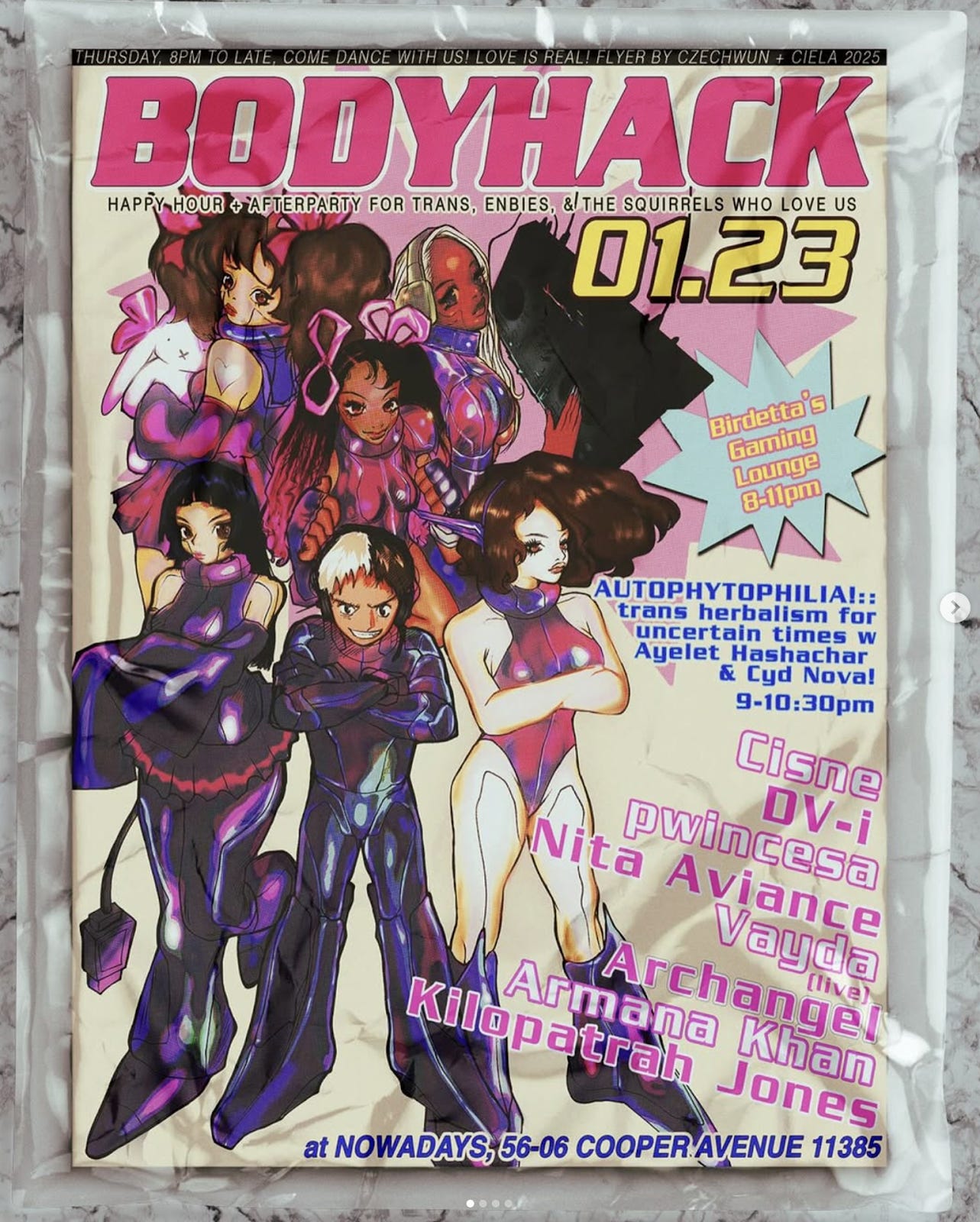
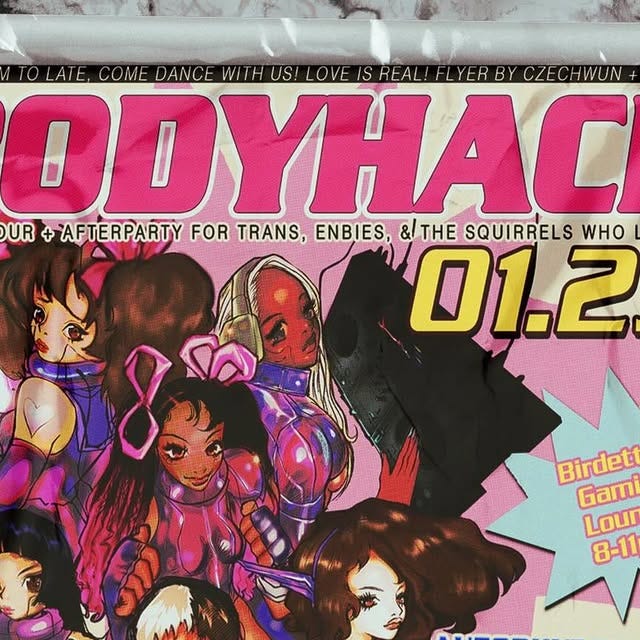
Outside of their comedic sans-serif text posts, BodyHack also curates a series of event fliers for each iteration of the monthly Thursday night affair, all of which borrow from and reimagine internet and technological aesthetics from the late 1990s to the early 2000s. Visuals range from Sanrio characters (e.g., Hello Kitty) situated within glitchy graphics and pixelated frames to custom-drawn images reminiscent of 1990s anime styles. One such event flier from January 2025 (fig. 4), designed by illustrator @czechwun on Instagram, features characters in suits of cyborg-esque armor in saturated purples and pinks. This image may remind the audience of the futuristic and robotic imagery from the anime Neon Genesis Evangelion, which premiered in 1997. Although the show does not explicitly highlight a queer narrative, many trans individuals in its online fandom have identified with the bodily struggles of protagonist Shinji, who is recruited to pilot a giant humanoid robot called a mech in order to fight evil. Some queer fans of the show have argued that Neon Genesis Evangelion is a trans narrative, since “Shinji’s at constant war with both his sexual identity and his performance of masculinity.”14 Neon Genesis Evangelion was marketed as a shounen anime, or a show specifically catered to an audience of young boys. It’s quite possible that a generation of transfemme and gnc individuals watched this show before coming out, perhaps identifying with the gender trouble of the protagonist. The flier, then, identifies Neon Genesis Evangelion as another marker of trans identity and situates it in the canon of trans internet culture.
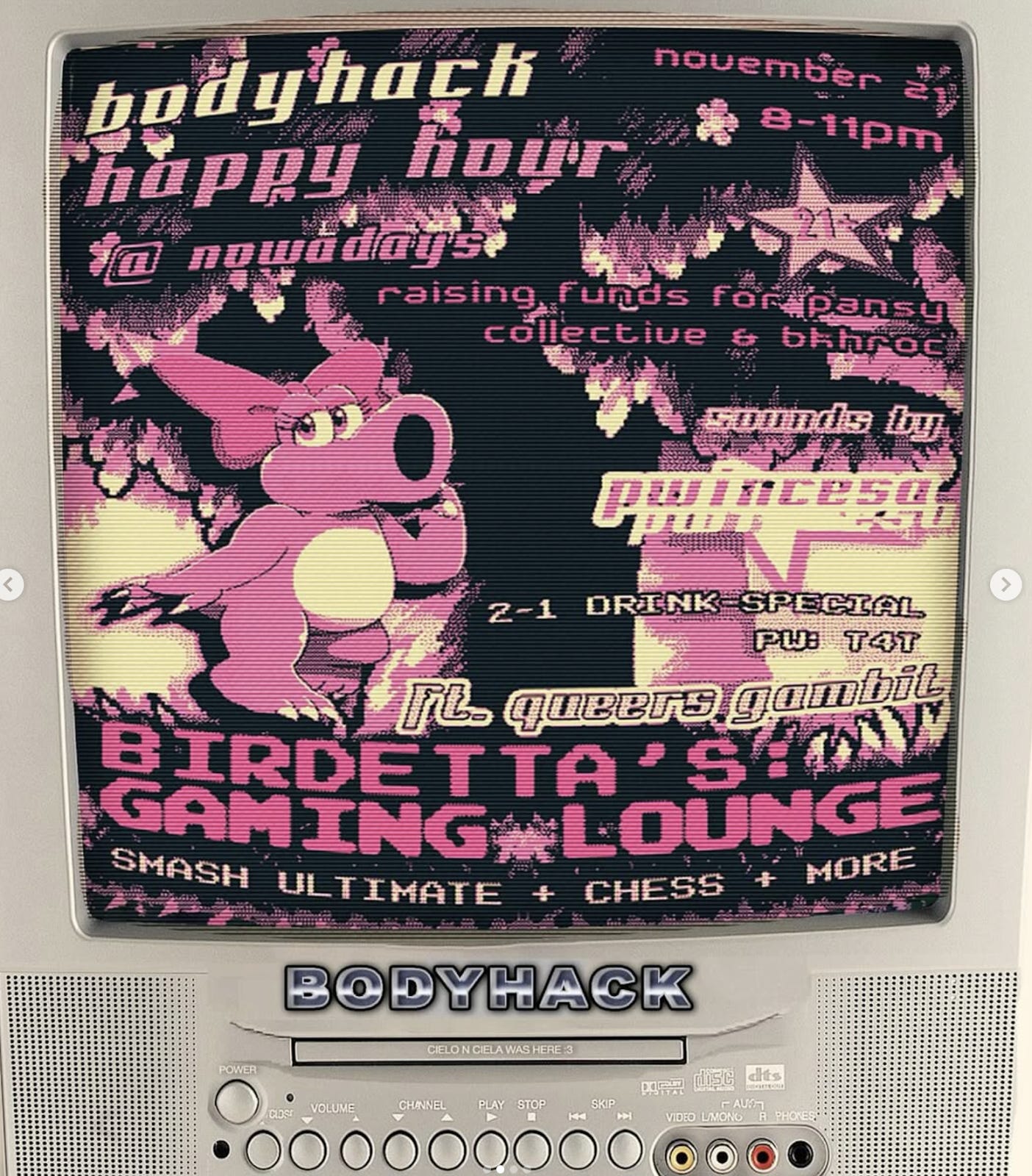
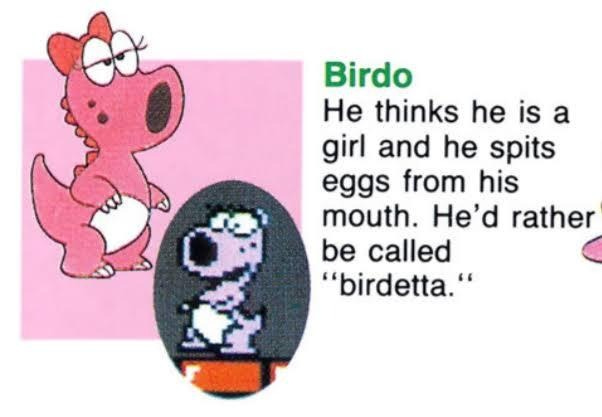
Shinji is not the only internet fan-favorite that maintains a trans narrative within BodyHack’s designs. The Nintendo character Birdetta, also referred to as Birdo, appears in many of the organization’s event posts, often accompanied by visuals of late 90s/early 2000s hardware. A post from November 13, 2024, references “Birdetta’s Gaming Lounge,” (fig. 5) BodyHack’s happy hour from 8-11pm that features a gaming area to play chess and one of various Nintendo Switch games. The internet has claimed Birdetta, a recurring character in popular Mario games for Nintendo consoles, as a trans icon due to an off-hand reference to her gender in a game manual. The manual for the NES game Super Mario Bros 2 (1988) refers to Birdetta using he/him pronouns but claims that the character “thinks he is a girl… He’d rather be called Birdetta” (fig. 6). Although this was likely due to a translation error from the game’s original Japanese into English, trans fans of the Mario franchise embraced Birdetta as one of their own, adopting imagery of the character into memes and online posts.
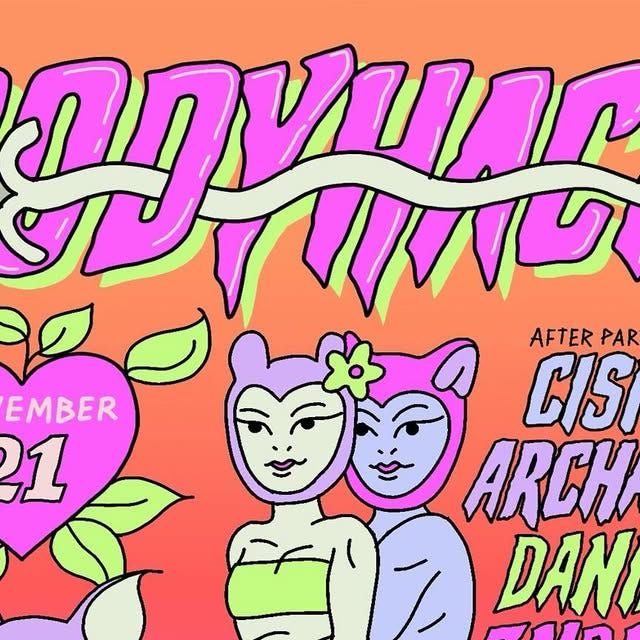
BodyHack’s designers draw on 1990s and 2000s nostalgia to attract attendees who are, then, mostly Gen Z, transgender, and involved in internet culture. This use of 90s and early 2000s aesthetics in design is often referred to online as “nostalgia core” or a “y2k aesthetic,” which incorporates elements of 90s and 2000s technological imagery with characters and motifs that were commonly seen by children growing up during that time. The aesthetic has widely been adopted by Gen Z on social media, which CNN writer Holly Thomas claims is “an understandable inclination. Romanticizing the noughties seems to play into Gen Z's reasonable desire for something recognizable, and less overwhelming than the grim (almost) post-pandemic, burning planet reality they're facing.”15 Nostalgia-core, then, become a means for queer self-expression and visibility, further emphasizing the futurity of the community at large through situating the past within the present and making it wholly new.
By including trans-coded characters like Shinji and Birdetta in their designs, along with nostalgia-core imagery and provocative rhetoric, BodyHack’s posts are “encrypted” to cisgender viewers.16 Encryption, as proposed by Russell, implies that the intricacies of trans identity, particularly as it pertains to one’s online presence, may be obscured to a cisgender audience. In this case, a cis viewer may not understand the implications of Birdetta and Shinji placed next to each other on an Instagram page filled with seemingly unrelated, provocative text. However, to a trans person, particularly a trans/gnc Gen Z individual, these images make sense in the same space. BodyHack’s online aesthetic is simultaneously distinct yet difficult to tie down, as it is constantly shifting while certain elements are constants. This “erratic” style is “intentional,” according to Russell, and “The information hidden by encryption becomes key, edges peeled back solely for those meant to see, process, understand.”17 BodyHack’s visual style is encrypted to only be intrinsically understood and interpreted by a transgender/gnc audience. It creates a unique digital space in which the audience is invited to participate in activities both online and AFK. Online presence is essential to contemporary understandings of queer existence since it has informed gender and sexuality constructions through shared learning and practices. BodyHack’s Instagram page is just one example of how one’s internet presence can translate both online and AFK, a world that exists both physically and digitally as a hybrid of both.
These posts intentionally use inside jokes and trans-centered rhetoric to both promote BodyHack and signal community over a shared understanding of internet culture. BodyHack’s event posts have evolved along with the organizers’ sense of humor, and as the US political climate became hostile towards trans/gnc people, the organizers began posting more and more absurd text posts to draw the attention of their desired audience. However, the seeming absurdity of these text posts is largely due to the cisgender-centric societal expectations for internet behavior. BodyHack’s posts are meant to scandalize a cisgender audience, subverting gender stereotypes and binary expectations. Further, the posts included here are just a few examples of the organization’s online presence as both a private and public sphere.
Russell points to the internet as being “a ‘room of one’s own,’” which speaks to the need for trans individuals to have specifically carved-out spaces on the internet to exist in community.18 Russell’s concept harkens back to Virginia Woolf’s pivotal 1929 essay, “A Room of One’s Own,” in which Woolf describes the need for women to have physical and metaphorical space to create and exist beyond the confines of the disenfranchisement placed upon them by society. Russell cites Woolf to further describe transness as “glitch,” and trans-centered internet spaces and identities as a means for this glitch to exist. Such is the case with BodyHack—the event’s online presence is a glitch in that it embodies trans identity through subversions of internet culture imposed by cisheteronormative society. Simultaneously, BodyHack’s Instagram page in particular acts as an online “room of one’s own” for trans/gnc individuals, envisioning a realm in which cisheteronormative expectations cease to exist.
“How I Made It: Partying All Day With ‘Body Hack,’” NPR, June 29, 2020, https://www.npr.org/2020/11/27/884976520/how-i-made-it-partying-all-day-with-body-hack.
“Livestream This: Body Hack’s Massive Party For Trans/Queer Community-Led Funds - PAPER Magazine.” https://www.papermag.com/body-hack-october#rebelltitem4.
Amy Harmon, “Transgender Americans Say Trump’s Orders Are Even Worse than Feared.,” The New York Times, January 29, 2025, sec. U.S., https://www.nytimes.com/live/2025/01/28/us/trump-news-executive-orders.
“Ending Radical And Wasteful Government DEI Programs And Preferencing,” The White House, January 21, 2025, https://www.whitehouse.gov/presidential-actions/2025/01/ending-radical-and-wasteful-government-dei-programs-and-preferencing/.
“LGB Travel Information,” US Department of State-Bureau of Consular Affairs, January 24, 2025, https://travel.state.gov/content/travel/en/international-travel/before-you-go/travelers-with-special-considerations/lgb.html/.
Isabella Gomez Sarmiento, “Stonewall Inn Protestors Stand against Recent Moves to ‘Erase Trans and Queer People,’” NPR, February 16, 2025, sec. National, https://www.npr.org/2025/02/16/nx-s1-5297882/stonewall-inn-protestors-stand-against-recent-moves-to-erase-trans-and-queer-people.
Reed Patrick Motti, “Tips for Updating Documents as a Trans Person Right Now,” Autostraddle, January 28, 2025, https://www.autostraddle.com/updating-documents-as-a-trans-person-is-hell-right-now-here-are-my-tips-for-navigating-the-process/?fbclid=PAZXh0bgNhZW0CMTEAAaYUGO9JvBj9coMZSBSA4UcniJCjlNUeAY7FIhXEF-GuC-m19FxVcZv1Em4_aem_C-Zp9PMzty9rmJzzN1dUjw.
Russell, Glitch Feminism, 7.
José Esteban Muñoz, Cruising Utopia: The Then and There of Queer Futurity (New York University Press, 2020), 1.
Carolina Are, “How Instagram’s Algorithm Is Censoring Women and Vulnerable Users but Helping Online Abusers,” Feminist Media Studies 20, no. 5 (August 8, 2020): 741–44, https://doi.org/10.1080/14680777.2020.1783805.
Sophie Caldwell, “What Is a ‘Short King?’ The Trending Title, Explained,” TODAY.com, July 9, 2024. https://www.today.com/life/short-king-meaning-rcna146190Caldwell.
Quispé Lopez, “I’m a Short Transmasculine Top. Here’s Why You Should Never Overlook Me,” Them, August 15, 2022, https://www.them.us/story/short-transmasc-top-essay.
Lopez.
Carol Grant, “‘Neon Genesis Evangelion’ Feels More Explicitly Queer Thanks to This Trans Voice Actor,” VICE (blog), July 12, 2019, https://www.vice.com/en/article/neon-genesis-evangelion-feels-more-explicitly-queer-thanks-to-this-trans-voice-actor-netflix/.
Holly Thomas, “Gen Z’s Telling Nostalgia for Bennifer, ‘Friends’ and Y2K.,” CNN Wire (CNN Newsource Sales, Inc., August 30, 2021), https://go.gale.com/ps/i.do?p=AONE&sw=w&issn=&v=2.1&it=r&id=GALE%7CA673720529&sid=googleScholar&linkaccess=abs.
Russell, Glitch Feminism, 87–88.
Russell, Glitch Feminism, 87-88.
Russell, Glitch Feminism, 42.